The second of the three
Rangas is the Ranganatha
Temple at Shivanasamudra.
Shivanasamudra is the
smallest of the three islands of Srirangapatna, Shivanasamudra and Srirangam.
The idol here and the temple too is the smallest among the three.
Shivanasamudra is not only a
religious centre but also a historical one. It is also the place where one can
see two beautiful waterfalls-Gganachukki and Barachukki and the power
generating station.
Shivanasamudra is accessible
by road from several places, including Bangalore,
Mysore, Mandya,
Malavalli and Chamarajanagar.
Since we are writing about
seeing the three rangas in a day, we will confine ourselves to the journey from
Srirangapatna to Shivanasamudra.
A small town in Mandya
district, Shivanasamudra forms the boundary to Chamarajanagar district. Several
decades ago it was called Heggur. It has the distinction of having Asia’s first hydro electric power station. This happened
way back in 1902. The western branch of the Cauvery forms the twin waterfalls
of Gaganachukki, whereas the eastern branch is the Bharachukki falls. The
Gaganachukki waterfalls are best viewed from the Shivanasamudra watch tower.
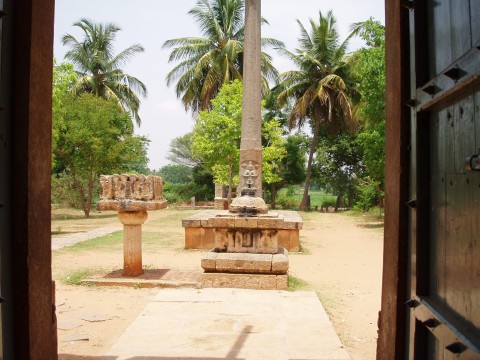
The Madhya Ranga is a small
but beautiful temple. The idol is also known as Jaganmohan Ranga. The Someshwara temple nearby has a idol of Meenakshi.
It is also called Meenakshi temple. There is a Srichakra here believed to have
been consecrated by Shankaracharya.
The journey from
Srirangapatna to Madhya Ranga takes a little over an hour. The nearest railhead
is Maddur.
There are scores of pilgrim and tourist places around
Shivanasamudra. They can be covered in a day or two. It is better to have your
own transport as some of the places are way off the tourist map. Let me start
with some better known tourist places.
Shimsha
This is near Shivanasamudra
but it is not as well known as the former. There is a beautifully located Inspection
bungalow overlooking the deep Shimsha valley where the river Shimsha joins the
Cauvery. You can reach this place by the road that branches off from the
main Maddur-Malavalli-Kollegal road
Talakad
This is the lost town of the
Gangas. It was once the capital of the Gangas till the Cholas overan it (It was
during the Gangas that the statue of Gomata was built at Shravanabelogala).
Several temples here are
buried under sand. The architecture of the temples is awesome. It is at this
spot that Alamulu, the wife of the Vijayanagar Viceroy of Srirangapatna, cursed
Raja Wodeyar. The curse said Wodeyars will not have any male heirs: that
Malagni will transform into a whirlpool and that Talakad will be buried under
sand.
The Pathaleshwara,
Maruleshwara, Arkeshwara, Vaidyanatheshwara and Mallikarjuna temples represent
the five lingas and consequently the five faces of Shiva. Hence, Shiva
here is called Pancha Pathi and the Panchalinga Darshana is held once in 12
years. The last such event was held in 2009.
The Cauvery here is fairly
deep and it is dangerous to venture into the middle. There are plenty of guides
to help you around the temples.
Talakad is 45 kms from Mysore and 133 kms from Bangalore. Talakadu is 27 kms from
Shivanasamudra. It is on the left bank of the Cauvery. It is here that the East
flowing Cauvery changes course. Therefore, there are many whirlpools.
Somanathapura
Twenty five kms from Talakadu
and 35 kms from Mysore
is Somanathapura which has one of the most exquisite Hoysala temple dedicated
to Somanatheswara or Chennakshava. The temple was built by Soma,
a Dandanayaka or commander in 1268 when Narasimha, the third, was
the Hoysala Emperor. This is the last major temple of Hoysala
dynasty.
The Temple is built on a raised platform so that
the devotees can perform pradakshina of the temple. It is stellar in shape and
the outer walls are beautifully carved.
Mudukuthore
This is a pilgrim centre on
the banks of the Cauvery. It is 48 km from Mysore, 25 km from Somanathapur,
18 kms from T. Narsipura and very close to Takalad. The temple of Lord Mallikarjuna is one of the Pancha
Linga temples.
It is believed that Arjuna,
the Pandava, stayed here and he consecrated the Shiva Linga here. Every year
during January and February, a week-long festival and fair is organised where
cattle and agricultural products are traded. This fair attracts thousands of
people.
The place is called Mudukuthore (break
and turn) as the Cauvery here takes a turn.
T Narsipura
Tirumakudalu Narasipura or
T Narsipura is the only place in south India to host Kumba Melas. A small
town in Mysore
district, it is situated at the confluence of three rivers-Cauvery, Kabini and
Spatika Sarovara or the mythical underground river.
The Skanda Purana rates T
Narsipura as one of the Trimakuta Kshetras or holy places with the confluence of three
rivers. The word Narasipur comes from
the famous Gunja Narasimhaswamy temple that is located on the right bank of
the Kabini.
This is just 14 kms from
Somanathapura and five kms from Takaladu.
Sosale
This is an important
religious centre and it houses the Sosale Vyasa Raja Matha. It is one the left
bank of the Cauvery. This Vyasa Raja matha is distrinct from the Abbur or
Kundapura Vyasaraja Matha. The Abbur Matha is headquartered at Abbur near
Chennapatna. The renowned Madhwa seer, Vyasa Raja, (1447-1539) visited this
place. The matha has brindavanas of nine saints and hence it is called Nava
Brindavana. (Do not confuse this with the Nava Brindavana at Hampi). It is
3 kms from T. Narsipura.
Bannur
This is another small town in
Mysore
district. It is famous for its sheep called Banur sheep. Not many know that
this is the place where the great Madhwa sage, Vyasa Raja, was born.The place
where he was born is now the Vyasa Raja Matha. There is a small idol to show
the place where he was born in 1447.
The Kodandarama temple and
theYoga Narasimha temples here are outstanding.
Bannur is 34 kms from
Takaladu, 64 kms from Mysore
and 14 kms from Sosale.
Kollegal
You will come across this
town when you head from Shivanasamudra to Srirangam. Kollegal is in
Chamarajanagar district and it is a well-known silk centre. Kollegal
is the main junction where you can Salem, Coimbatore, Ooty, Mysore, Bangalore, Shivanasamudra and Kozhikode.
Chamarajanagar at 30 kms away is the nearest railhead.
Kollegal is 30 kms away from
BR Hills and it has easy access to MM hills and several forest and picnic
spots. There are many temples in Kollegal.
Shivanasamudra isjust 15 kms
away. Maradi Gudda in Kollegal is a famous place as is the Gundal
reservoir.
Maddur
Today, this town on the
Bangalore-Mysore highway is known for its Maddur vada. This is in Mandya
district and it is 19 kms from Mandya city and 81 kms from Bangalore. It is a little over 40 kms from
Shivanasamudra.
The Ugra
Narasimha Temple
has sannidhis for Ugra Narasimha, Sowmya
Nayaki, Narasimha Nayaki, Rama, Sita,
Lakshmana, Hanuman, Yashoda, Krishna,
Srinivasa and the alwars.
The temple is unique and Yashoda
is seen breast feeding Krishna in the sanctum.
Brahma is seen held from Krishna's nabhi.
Arjuna wanted Krishna to give him a darshan of Narasimha.
Krishna advised Arjuna that he would be
able to see Narasimha as he was a Ugra (angry) avatar. He, therefore, requested
Brahma to craft a stone replica of Ugra Narasimha. This was installed in Maddur
temple andArjune had his wish fulfilled.
In earlier days, Maddur was called Arjunapuri as Arjuna
worshipped in this temple. Later, Kadamba rishi came and worshipped here.
Another famous temple is that
of Varadaraja Swamy which was by the
Hoysala Emperor Vishnuvardhan. The Emperor’s mother was blind and Ramanujacharya, the
Srivaishnava saint philosopher, asked Vishnuvardhana to take his mother to
Kanchi Varadarajaswamy temple for curing her blindness.
As she was too old to travel,
Varadaraja came in the dream of t Vishnuvardhana and ordered him to construct the
temple in Maddur itself. The king got artistes from Kanchi and created the idol
of Sri Varadaraja. After the installation of the idol, a mandala pooja -48 days
pooja- was perfoemed and on the forty eighth day when the Emperor’s mother came
to worship the God, her eyesight was restored. The Varadaraja here is also
called as Nethra Narayana.
Kokrebellur
Very near Maddur (13 kms away
and 95 kms from Bangalore)
is the world famous bird sanctuary of Kokre Bellur. This is just off the
Bangalore-Mysore road. During October and November every year, the village of Kokre Bellur transforms into a home to
migratory birds. Flocks of painted storks (ibis leucocephalus) and spot billed
pelicans (pelecanus philippenis) come here to build their nests and rear their
young. The trees are always swarming with storks and pelicans.
Malavalli
The presiding deity of Marehalli Temple here Sri Lakshmi Narasimha Swamy
(Perumal Narasimha who is in a sitting posture with Lakshmi on his lap).
The deity is a chaturbhuja –
having four hands. The ancient temple is enormous in size. A canal carrying
Cauvery water runs in front of the Temple.
Bhimana Kindi
This is natural rock
formation. It is located at Bhimana Kindi in Malavalli taluk of Mandya district.
The arch formation of the rock is over the hill. It is a breathtaking place
near Kanchina Halli village. It is on the Chennapatna route via Halaguru.
Muthathi
Muthathi or Muttatti
is on the banks of the Cauvery near Malavalli. It is surrounded by dense forest which is the
home of the Cauvery Wildlife Sanctuary. Muthathi
is associated with Seetha, Rama and Hanuman. Many animals such as deer,
elephants, squirrels and several species of birds can be spotted. The river here
has several whirlpools and powerful
currents which have led to the deaths of several people. In the last three years,
108 people have died here and of them Bangalore
accounts for 85.
Muttatti is 40 kms from
Malavalli.
Bhimeswari
One of the world’s best
angling camps is in Bheemeswari which is in Malavalli taluk. This also called Cauveri
fishing camp. It is regared as a perfect picnic and fishing spot for masheer near
Muthathi. Bheemeswari is located in between Shimsha and Mekadatu. You
can easily spot crocodiles, wild boars, jackals, leopards and birds. This place
is a natural habitat for Masheer fish.
The Jungle Lodges and Resorts
operate resorts here.
Chennapatna
Seventy two kilometers away
from Shivanasamudra and twenty kms from Maddur is the toy town of Chennapatna. This is a
famous silk centre and it is also called as Toy town as it manufactures a
variety of wooden toys. The toy industry was first introduced here by Tippu
Sultan.
Chennapatna is known for some
of the finest temples. Ramanujacharya consecrated the Varadaraja (Srinivasa)
temple here. The Madhwa saint, Vyasa Raja, also built a Srinivasa temple here.
Both the temples are near to each other.
Near Chennapatna is the Apremaya Swamy Temple.
Rama, Lakshmana and Sita came here during their Vanavasa. The Srinivasa idol
here is magnificent and there are several legends about it. There is an idol of
Krishna which is called Ambegallu Krishna.
Purandara was so enraptured by it that he burst into a song “Jagododarana”.
Abbur
There are several other places like Abbur which houses the Brindavana of Bramanye Theertha and it belongs to the Abbur or Kundapura Matha. Nearby is the cave or Guhe where Purushottama Theertha, the guru of Nramanye Theertha, disappeared in a cave. The cave is accessible but the road is bad and you have to trek through fields to go to the place. There is an Anjaneya Temple here.
Bramanyepura
This is the small town that Bramanye Theerha founded sometime in the 15th century. It is just before Chennapatna when you approach it from Bangalore side. Just after the Chennapatna lake on your left on the Bangalore-Mysore highway, you will find a lot of autos parked on a road. Take this road and it winds its way to this obscure village.
There is a Hanuman here and it was consecrated by three Madhwa seers-Bramanye Theertha of Abbur Matha, his cousin brother, Sripadaraja of Mulabagal Matha and Vyasa Raja of Vyasa Raja Matha. Purandara Das also visited this shrine and sung a song.
There is an old house belonging to the archaka of this small temple. He says this was the house which Bramanye Theerthe himself constructed. Only a portion of an inner wall remains and the rest have been repaired and reconstructed.
Kambada Narasimha
This is a temple which you come across on the road to Bramanye Pura. As you turn left from this road to Bramanye Pura, you can see a Garuda Sthamba on the middle of the road. Stop here and yopu can see a hillock a little distance away. The Kambada Narasimha Temple is on this hillock.
Legend has it that Purushottama Theertha used to worship the Kambada Narasimha every day walking from Abbur, which is 8 kms away. After him, Bramanye Theertha followed the practice. However, he found it a difficult task to carry holy water to perform abhisheka all the way from Abbur. He then constructed the Bramanye Sarovara nearby.
The Maddur-Chennapatna-Kanakapura sector has several hill and trek places. The entire areas is full of temples, hill ranges and small tanks and lakes. All these are easily accesible provided you have your own transport. The Maddur-Mandy-Chennapatna sector is full of eateries and some of the best hotels and restaurants. Nature is at its best here.